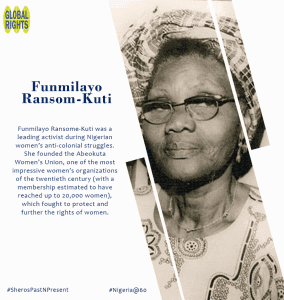
Funmilayo Ransome-Kuti
Funmilayo Ransome-Kuti was born in Abeokuta, in present-day Ogun State, Nigeria. She was one of the first women to attend Abeokuta Grammar School in 1914, where she later taught.
Soon after her education in the United Kingdom and her return to Nigeria in 1922, she became associated with some of the most important anti-colonial educational movements in Nigeria and West Africa, and fought tirelessly to further women’s access to education and political representation.
In 1932, when her husband became principal of the Abeokuta school, she helped organize the Abeokuta Ladies Club (ALC), initially a civic and charitable group of mostly Western-educated Christian women. The organization gradually became more political and feminist in its orientation, and in 1944 it formally admitted market women (women vendors in Abeokuta’s open-air markets), who were generally impoverished, illiterate, and exploited by colonial authorities. In 1946 the ALC changed its name to the Abeokuta Women’s Union (AWU) and opened its membership to all women in Abeokuta. The Union became one of the most important women’s movements of the twentieth century. Ransome-Kuti became the first president of the AWU (1946) and headed its successor organizations until her death. Under her leadership the AWU became a national organization, renaming itself the Nigerian Women’s Union (NWU) in 1949 and the Federation of Nigerian Women’s Societies (FNWS) in 1953.
Her unwavering commitment to cooperation, solidarity and unity led her to play an active role in politics, notably in the pre-independence constitutional negotiations of 1946.
Her children Beko, Olikoye and Fela, later went on to play important roles in education, healthcare, the arts and political activism.